

At Tosten Marketing, we’re excited to explore the power of local search algorithms in artificial intelligence. These techniques are revolutionizing how AI systems find optimal solutions in complex problem spaces.
In this post, we’ll break down the key concepts of local search, compare popular algorithms, and provide practical tips for implementation. Whether you’re a seasoned AI developer or just starting out, you’ll gain valuable insights into harnessing local search for your AI projects.
What Is Local Search in AI?
The Basics of Local Search
Local search algorithms in AI are powerful tools that find good solutions to complex problems quickly. These techniques optimize various aspects of digital marketing strategies for insurance agencies.
Local search in AI is a problem-solving approach that starts with an initial solution and iteratively makes small changes to improve it. Instead of examining every possible solution (which could take an eternity), local search focuses on exploring nearby options. This method proves particularly useful for problems with vast solution spaces, such as optimizing website layouts or fine-tuning SEO strategies.
Local vs. Global Search Methods
Unlike global search methods that attempt to find the absolute best solution across all possibilities, local search aims for good enough solutions in a reasonable timeframe. This approach is often more practical for real-world AI applications where time and computational resources are limited.
Local search methods have proven invaluable for tasks like keyword optimization. Rather than exhaustively analyzing millions of keyword combinations, local search algorithms iteratively refine a set of keywords, focusing on those that show the most promise for improving search rankings and lead generation for insurance agency clients.
Strengths of Local Search
The main advantage of local search is its efficiency. It can quickly find high-quality solutions for complex problems, making it ideal for time-sensitive tasks like real-time ad bidding or content personalization. Local search algorithms are also generally easier to implement and require less computational power than more exhaustive methods.
Limitations and Challenges
Local search isn’t without its drawbacks. The most significant limitation is the risk of getting stuck in local optima – solutions that are better than their immediate neighbors but not necessarily the best overall. To mitigate this, techniques like random restarts or simulated annealing are often employed in AI-driven marketing tools.
Another challenge is that the effectiveness of local search heavily depends on how well the problem is structured and how the neighborhood of solutions is defined.
When optimizing social media strategies for insurance agency clients, carefully defining what constitutes a “nearby” strategy (e.g., slight changes in posting frequency or content mix) is essential for achieving meaningful improvements.
Application in Digital Marketing
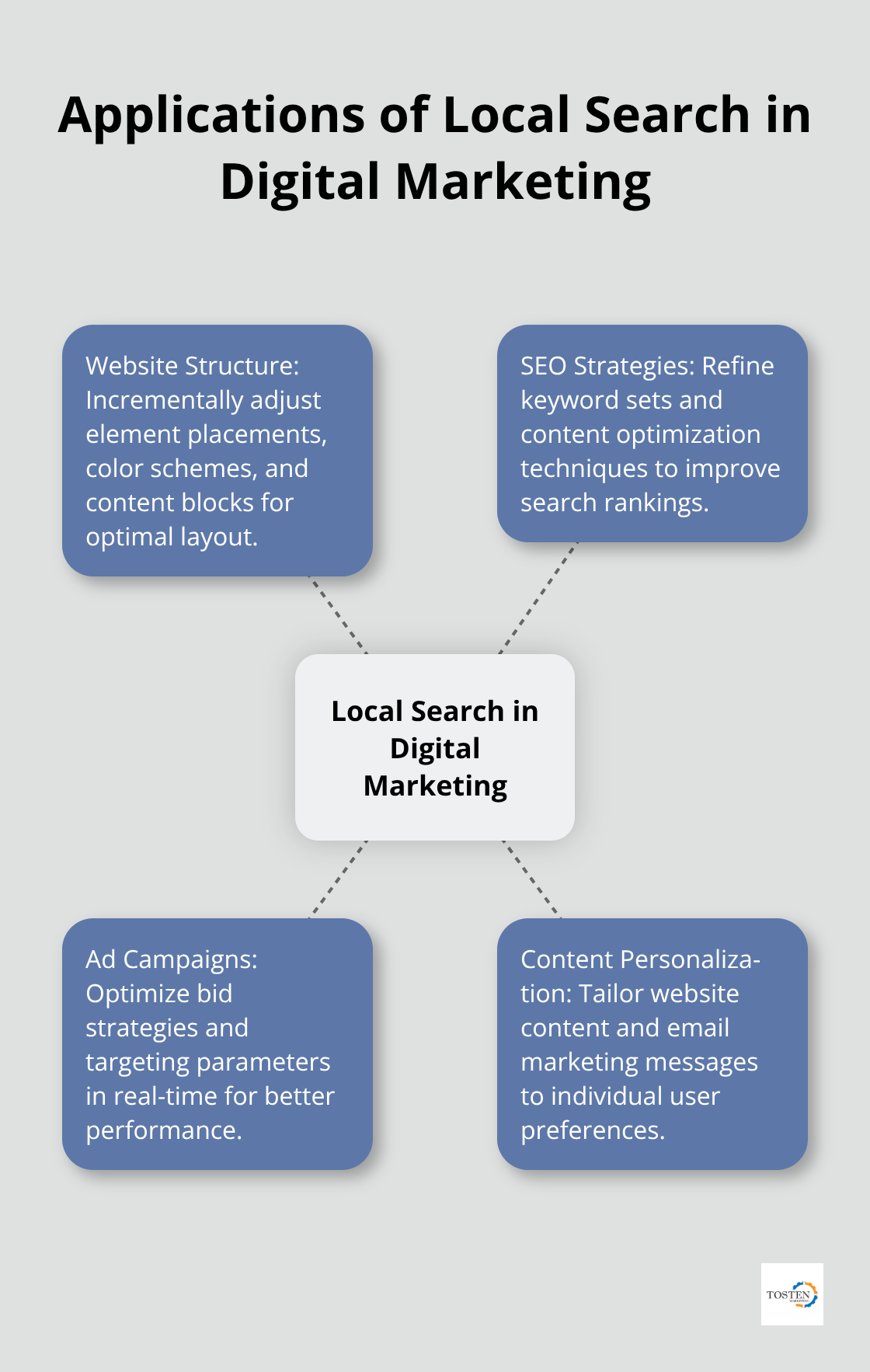
In the context of digital marketing for insurance agencies, local search algorithms can optimize various elements:
- Website Structure: Starting with a basic layout and incrementally adjusting element placements, color schemes, and content blocks.
- SEO Strategies: Refining keyword sets and content optimization techniques.
- Ad Campaigns: Optimizing bid strategies and targeting parameters in real-time.
- Content Personalization: Tailoring website content and email marketing messages to individual user preferences.
As we explore the intricacies of local search algorithms, it’s important to understand the specific techniques that make these optimizations possible. Let’s examine some of the most common local search algorithms used in AI applications.
Which Local Search Algorithms Drive AI Success?
Hill Climbing: The Foundation of Local Search
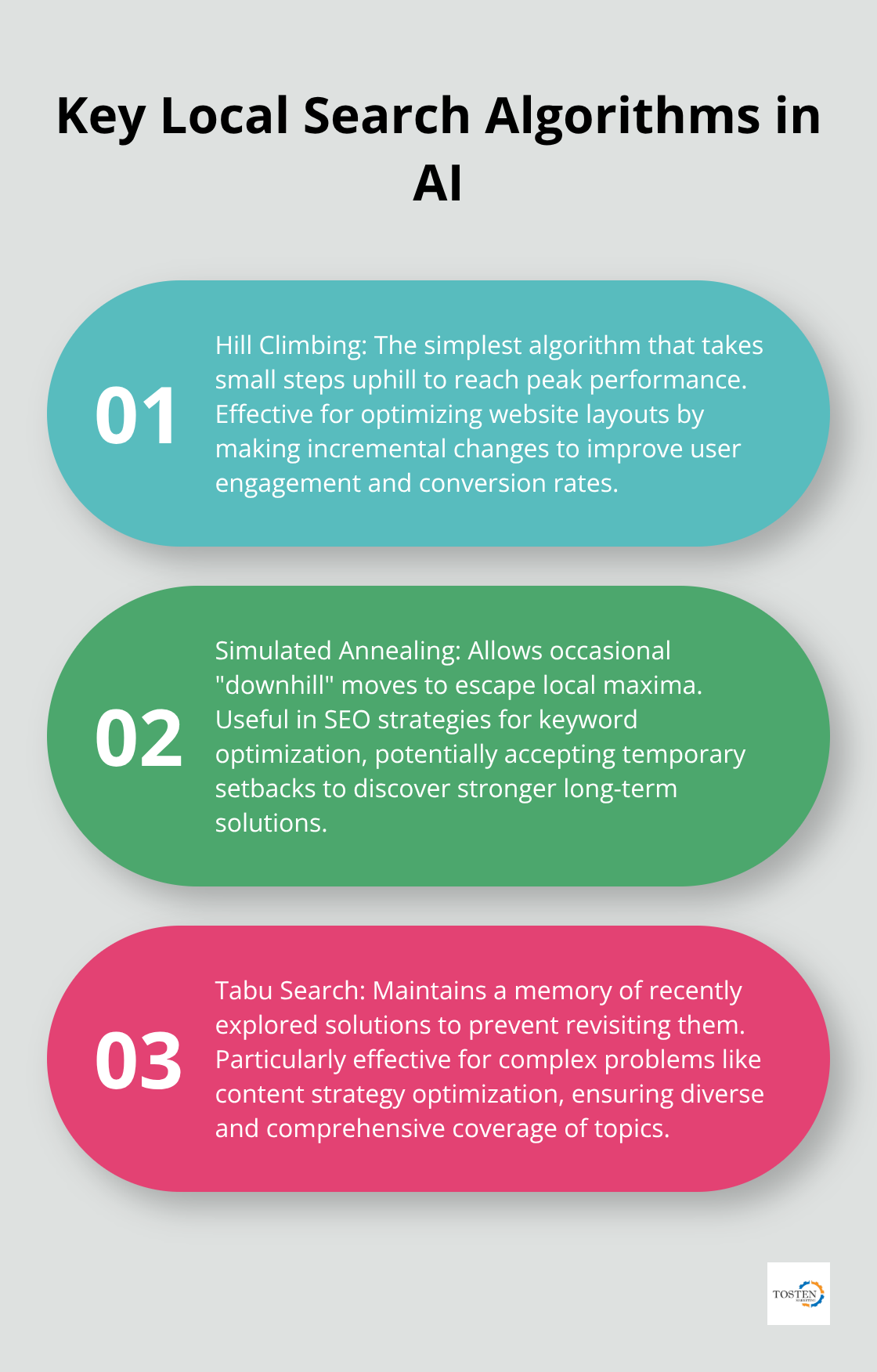
Hill Climbing stands as the simplest yet often most effective local search algorithm. It takes small steps uphill to reach the peak of performance. In practice, Hill Climbing optimizes website layouts for insurance agencies. We start with a basic design and make incremental changes, always moving towards layouts that increase user engagement and conversion rates.
When we optimize a landing page, we adjust the position of the call-to-action button, tweak the headline, or modify the color scheme. We evaluate each change based on user interaction data and keep the modifications that show improvement. This process continues until we reach a point where no single change leads to better performance.
Simulated Annealing: Escaping Local Maxima
While Hill Climbing proves powerful, it can sometimes get stuck on small peaks, missing out on higher summits nearby. Simulated Annealing shines in these situations. This algorithm allows for occasional “downhill” moves, which helps to escape local maxima and potentially find even better solutions.
In SEO strategies for insurance agents, Simulated Annealing applies to keyword optimization. We might temporarily accept a keyword set that performs slightly worse if it opens up the possibility of discovering a much stronger set in the long run. This approach can lead to significant improvements in organic search traffic compared to standard Hill Climbing methods.
Tabu Search: Learning from the Past
Tabu Search enhances local search by maintaining a memory of recently explored solutions, preventing the algorithm from revisiting them. This approach proves particularly effective for complex, multi-faceted problems like content strategy optimization.
When we develop content calendars for insurance agencies, Tabu Search ensures a diverse mix of topics that cover all aspects of insurance while avoiding repetition. By keeping track of recently covered themes, we create a more engaging and comprehensive content strategy that addresses a wider range of customer needs and search intents.
Local Beam Search: Parallel Problem-Solving
Local Beam Search takes a different approach by maintaining multiple candidate solutions simultaneously. This parallel processing can lead to faster and more robust results, especially for problems with many interdependent variables.
Local Beam Search applies to ad campaign optimization processes. We simultaneously test multiple ad sets with slight variations in targeting, bidding strategies, and creative elements to quickly identify the most effective combinations. This approach can reduce client ad spend while increasing click-through rates.
The implementation of these algorithms requires careful consideration of the specific problem at hand and the available data. Companies like Tosten Marketing have developed suites of tools that leverage these algorithms to deliver tailored, high-performance marketing solutions for insurance agencies. The combination of local search algorithms with industry expertise allows for navigation of the complex digital marketing landscape and drives measurable results for clients.
Now that we’ve explored the power of these local search algorithms, let’s examine how to implement them effectively in AI applications for maximum impact.
How to Implement Local Search in AI for Marketing
Define the Problem Space
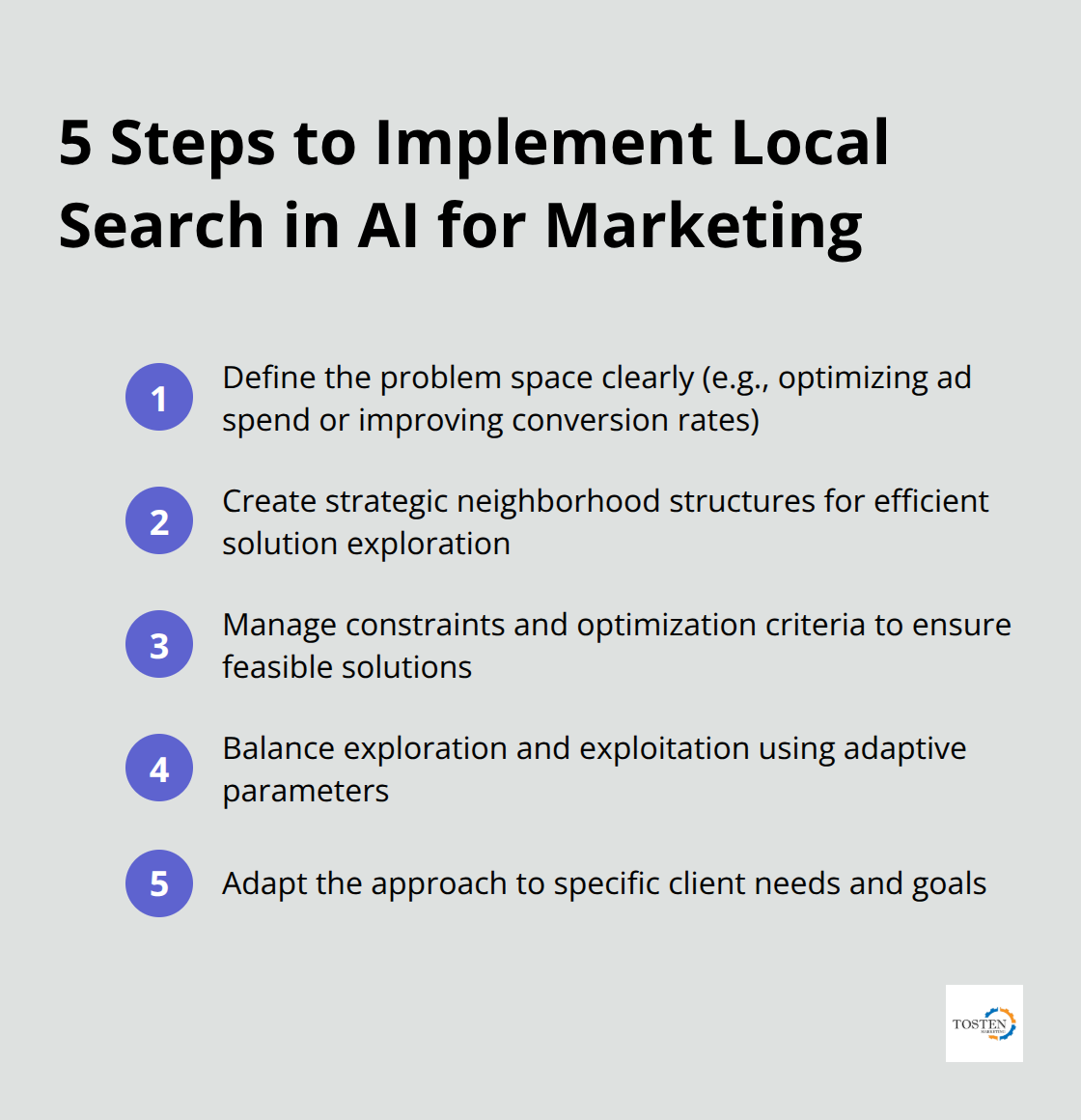
The first step in implementing local search is to clearly define the problem you want to solve. For insurance agency marketing, this could involve optimizing ad spend, improving website conversion rates, or enhancing email open rates. The more specific the problem definition, the more effective the local search algorithm becomes.
For example, when optimizing ad spend, we define the problem as maximizing the number of qualified leads generated per dollar spent. This clear definition allows us to create a focused objective function that guides the local search process.
Create Strategic Neighborhood Structures
The effectiveness of local search algorithms heavily depends on how we define the “neighborhood” of potential solutions. A well-structured neighborhood can dramatically improve the algorithm’s performance.
For website optimization, we define the neighborhood as a set of small, incremental changes to the current layout. This might include adjusting the position of call-to-action buttons, tweaking headline copy, or modifying color schemes. By focusing on these small, manageable changes, we can efficiently explore the solution space and find improvements quickly.
Manage Constraints and Optimization Criteria
Real-world marketing problems often come with constraints. For insurance agencies, these might include budget limitations, regulatory requirements, or brand guidelines. Effective implementation of local search requires careful handling of these constraints.
We can incorporate constraints directly into the objective function. This approach ensures that the algorithm always produces feasible solutions while still optimizing for the desired outcome. For example, when optimizing ad campaigns, we include budget constraints as part of the evaluation criteria, ensuring that the algorithm never suggests solutions that exceed the client’s spending limits.
Balance Exploration and Exploitation
One of the most challenging aspects of implementing local search is striking the right balance between exploration (searching for new solutions) and exploitation (refining known good solutions). Too much exploration can lead to wasted resources, while too much exploitation can result in missed opportunities.
An effective approach involves using adaptive parameters that adjust the balance based on the algorithm’s progress. In the early stages, we allow for more exploration to broadly survey the solution space. As the algorithm progresses and finds promising areas, we gradually shift towards exploitation to fine-tune the best solutions.
This adaptive approach has proven particularly effective in SEO optimization. We start with a wide range of keyword combinations and content strategies, then progressively focus on refining the most successful elements as we gather more data on their performance.
Adapt to Specific Client Needs
Implementing local search in AI for marketing is not a one-size-fits-all process. It requires careful consideration of the specific problem, constraints, and goals of each insurance agency client. We try to focus on these key areas: problem definition, neighborhood structure, constraint management, and exploration-exploitation balance.
As AI technology continues to evolve, so too will the methods for implementing local search algorithms. Staying at the forefront of these developments allows us to continually refine our approach and deliver even better results for insurance agencies looking to optimize their digital marketing efforts (through techniques such as improved keyword targeting and more efficient ad spend allocation).
Final Thoughts
Local search algorithms in artificial intelligence have transformed digital marketing for insurance agencies. These powerful techniques optimize website performance, SEO rankings, and ad campaigns with remarkable efficiency. We at Tosten Marketing have witnessed the impact of these algorithms firsthand, helping our clients achieve significant improvements in their online presence.
The future of local search in AI promises even more sophisticated applications. Advancements in machine learning and data processing will likely lead to more adaptive and context-aware algorithms, enabling precise optimization of marketing strategies. These technologies will open up new possibilities for personalization, real-time optimization, and data-driven decision-making in the digital landscape.
Insurance agencies that embrace AI-powered strategies will stay competitive and reach new heights of success. Tosten Marketing remains committed to integrating cutting-edge techniques (including local search algorithms in artificial intelligence) to deliver exceptional results for our clients. Our team’s expertise in digital marketing for insurance agencies ensures that we can harness the full potential of these powerful tools.